Have you ever noticed numbers such as 205/55R16 printed on the side of a car tyre?
These markings contain important information about tyre dimensions and construction.
Understanding tyre sizes can help vehicle owners select suitable replacement tyres and avoid compatibility problems.
Understanding Tyre Size Numbers
Consider the example:
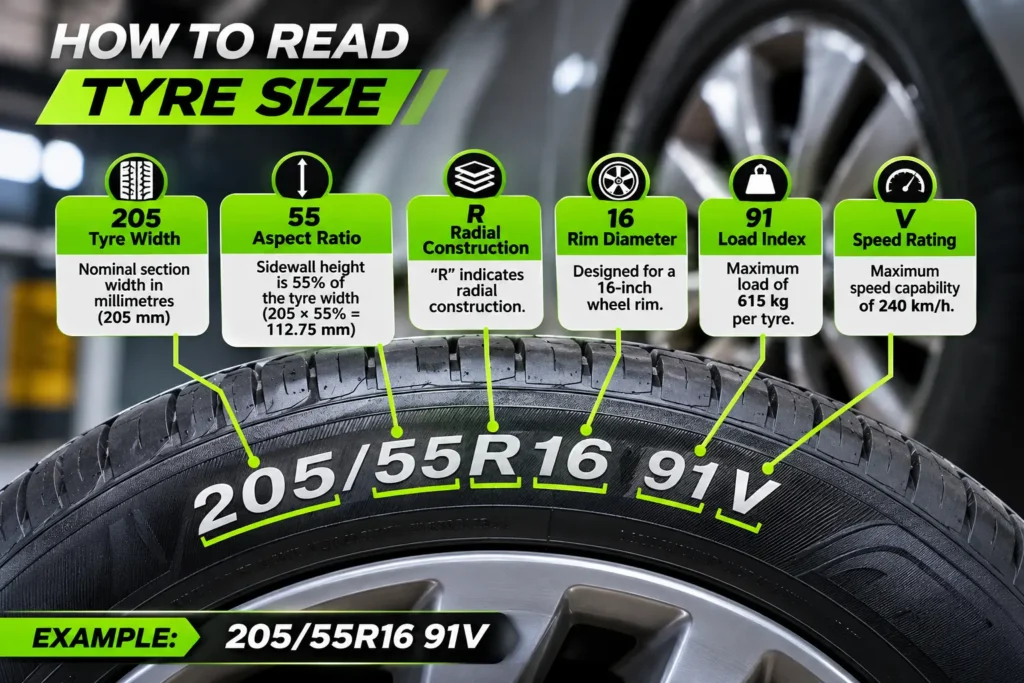
205/55R16 91V
Each number and letter represents a different tyre specification.
205 — Tyre Width
The first number indicates the tyre’s nominal section width in millimetres.
In this example, the tyre has a nominal section width of 205 mm.
55 — Aspect Ratio
The second number represents the sidewall height as a percentage of the tyre’s nominal width.
For a 205/55 tyre:
Sidewall height = 205 × 55% = 112.75 mm
This is the nominal sidewall height, not a direct measurement of the installed tyre.
R — Radial Construction
The letter R indicates that the tyre uses radial construction.
Radial tyres are widely used in modern passenger vehicles.
16 — Rim Diameter
The number 16 indicates that the tyre is designed for a wheel with a 16-inch rim diameter.
The tyre must match the wheel’s rim diameter.
91 — Load Index
The load index indicates the maximum load capacity of the tyre under specified conditions.
A load index of 91 corresponds to a maximum rated load of 615 kg per tyre.
V — Speed Rating
The speed rating indicates the tyre’s certified maximum speed capability under specified conditions.
A V speed rating corresponds to 240 km/h.
This rating is not a recommendation to drive at that speed. Drivers must always follow applicable speed limits.
Why Is Choosing the Correct Tyre Size Important?
Using an unsuitable tyre size may affect:
- Vehicle handling and stability.
- Speedometer accuracy.
- Ride comfort.
- Braking performance.
- Wheel and suspension clearance.
- Compatibility with vehicle safety systems.
Tyre load and speed ratings are also important considerations.
Can You Change Your Car’s Tyre Size?
Some vehicles permit alternative tyre sizes, but compatibility must be carefully checked.
Factors include overall tyre diameter, wheel width, clearance, load rating, and manufacturer recommendations.
Changing tyre size without proper assessment can affect vehicle performance and safety.
How to Find the Correct Tyre Size
Vehicle owners can usually find recommended tyre specifications in:
- The vehicle owner’s manual.
- The tyre information label on the driver’s door frame.
- Manufacturer-approved wheel and tyre specifications.
The size currently fitted to a used vehicle may not always be the original recommended size.
How Often Should Tyres Be Inspected?
Tyres should be inspected regularly for:
- Low or incorrect inflation pressure.
- Uneven tread wear.
- Cuts, cracks, and bulges.
- Embedded objects.
- Excessive tread wear.
Check tyre pressure when the tyres are cold and use the pressure recommended by the vehicle manufacturer.
Frequently Asked Questions
What does R16 mean on a tyre?
R indicates radial construction, while 16 indicates a 16-inch rim diameter.
Can I use 205/55R16 instead of 195/55R16?
Not automatically. The change affects tyre width and overall dimensions. Vehicle and wheel compatibility must be verified.
What happens if the tyre load index is too low?
A tyre with insufficient load capacity may not safely support the vehicle under its intended operating conditions.
Conclusion
Understanding tyre size markings helps drivers make better decisions when replacing tyres.
Always confirm tyre dimensions, load index, speed rating, and vehicle compatibility before selecting replacement tyres.